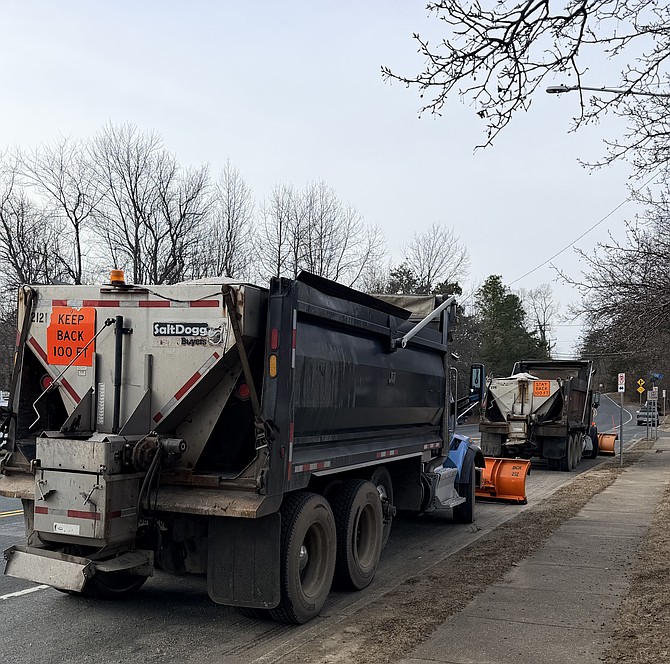
As the region prepared for the predicted heavy ice and snow event on the Jan. 24 weekend, VDOT trucks rolled out to pretreat area roadways. Brine solutions are designed prevent ice from adhering to road surfaces on interstates, major highways and throughways. Once an inch of snow accumulated on those roads, treatment switched to pure rock salt to lower the freezing point of water, melting snow and ice. On subdivision streets, plowing and sand were the preferred VDOT treatments; as property owners shoveled and considered using salt on sidewalks.
Use of brine, calcium chloride solutions, and rock salt for maintaining winter safety has come under increased scrutiny in recent years. Groups like the Northern Virginia Regional Commission (NVRC), the Virginia Department of Environmental Quality (DEQ), Fairfax Water, the Interstate Commission on the Potomac River Basin (ICPRB), and the Chesapeake Bay Foundation, have pushed the need to balance using salt for safety with its negative impacts on water quality, pipes, bridges, and the environment. An annual awareness campaign in our area, Winter Salt Week, observed the last week in January, highlights salt pollution from de-icing and promotes “smart salt” use.
The key messages: You only need a little salt to tame ice; and too much salt pollutes water permanently.
It’s such an important message that Del. Kathy Tran (D-18) sponsored a Joint Resolution (HJ46) in the General Assembly this year, seeking to make the annual Winter Salt Week a state-wide observance. Tran is a legislative member of the Interstate Commission on the Potomac River Basin (ICPRB), part of the Northern Virginia Winter Salt Workgroup. The Winter Salt Workgroup is a coalition of organizations working to reduce road salt pollution throughout the region.
“I’ve been aware of how excess road salt can pollute our waterways, so when the ICPRB staff raised the idea with me of Virginia designating Winter Salt Week, I agreed it is something we can do to increase knowledge of this issue,” Tran said. “Winter salt helps clear our roads for safe travel, but when it is overused, it doesn’t disappear when the snow melts — rather winter salt ends up in our rivers, reservoirs, and drinking water. I proposed designating the week of the fourth Monday in January beginning in 2027 as Winter Salt Week to help constituents, businesses, and local and state governments use the right amount of winter salt so we can protect our waterways for future generations.”
Why Is Salt Harmful?
As salt runoff from road/sidewalk/yard use eventually makes its way into storm drains, creeks and rivers, it increases salinity in groundwater and local waterways, harming freshwater fish and other aquatic life, and polluting drinking water sources. The Chesapeake Bay watershed is home to more than 18.5 million people and provides habitat to an estimated 3,500 species of plants and animals which depend on unpolluted water.
Run-off in Fairfax County eventually makes its way to the Potomac River and Occoquan Reservoir drinking water sources. In drinking water, higher salinity presents human health risks. Over 90% of American adults consume more than the recommended 2,300 milligrams of sodium per day, according to the AMA. Intake averages 3,400 mg daily, increasing risks for high blood pressure, heart disease and stroke. Salt cannot be removed through traditional drinking water and wastewater treatment processes at treatment facilities.
According to Fairfax Water, processes such as reverse osmosis and desalinization exist, but are extremely expensive to build, operate and maintain at a drinking water treatment facility; in part because of large energy consumption.
Salt is corrosive. It impacts community infrastructure including water and sewer pipes, roads, bridges, sidewalks, and parking lots, raising infrastructure maintenance costs. It also can impact household plumbing for which homeowners are responsible. It’s chloride component can corrode home metal plumbing, fixtures, and appliances with metal parts; such as dishwashers and laundry machines.
How Does Local Drinking Water Measure Up Now?
Fairfax Water services the water needs of over two million customers, producing an average of 170 million gallons of clean water daily; with a 345 million gallon production capacity. Their 2025 annual report on water quality, which analyzes 2024 collection data, reports 16 - 25, and 12.9 - 44.2 ppm (parts per million ) of sodium in its “finished” water at the Potomac and Occoquan sources treatment facilities, respectively.
Fairfax Water shares, “The differences in sodium levels between the Occoquan Reservoir and the Potomac River are primarily due to variations in watershed size, land use and water management practices. The Potomac watershed contains a higher percentage of forested lands as compared with the Occoquan watershed. The Potomac River is a much larger body of water, so it naturally dilutes sodium more effectively. In contrast, the Occoquan Reservoir is smaller, which can concentrate sodium levels.”
With no allowable state or federal levels established for sodium content, when asked if sodium in our water is at acceptable levels, Fairfax Water responded, “Fairfax Water is committed to providing safe, high-quality drinking water for our customers. The rising levels of salt in our source waters are not acceptable to us. Elevated salt concentrations can impact water quality, infrastructure, and the environment. We strongly encourage everyone — residents, businesses and local agencies — to take steps to reduce salt use, especially during winter months. Simple actions like using the right amount of de-icing material, sweeping up excess salt, and exploring alternatives can make a big difference.”
How Much Salt for Winter Safety?
Just one teaspoon of salt pollutes five gallons of water, creating permanent freshwater salinization; a danger for the nation’s freshwater supply over time. While road salts, applied at a rate of about 20 billion tons in the U.S. each year, contribute heavily to the problem, there are several other contributors. They include weathering of concrete, input from sewage and animal wastes, lawn irrigation with recycled water, application of lawn fertilizers, and water softeners, to name a few.
Fairfax Water shares a few tips for using less winter salt on its website: https://www.fairfaxwater.org/winter-salt.
Their suggestions include: use salt sparingly and only when needed; shovel before ice forms; use only one 12 oz mug to treat a 20 foot driveway, or about 10 sidewalk squares; scatter salt evenly, not in clumps; sweep up excess salt after ice melts for reuse; and salt is not effective below 15 degrees - so don’t use salt ineffectively. Also consider alternatives like sand, or calcium magnesium acetate, another de-icer, for traction instead of salt.
Fairfax Water’s general manager and CEO, Jamie Hedges, says, “Public involvement is essential. Salt used during the winter doesn’t disappear — it ends up in the drinking water supply. When individuals use salt wisely, they help protect our drinking water, aquatic life and infrastructure. Small changes can lead to big improvements for our watersheds.”